
electrostatic filter cotton
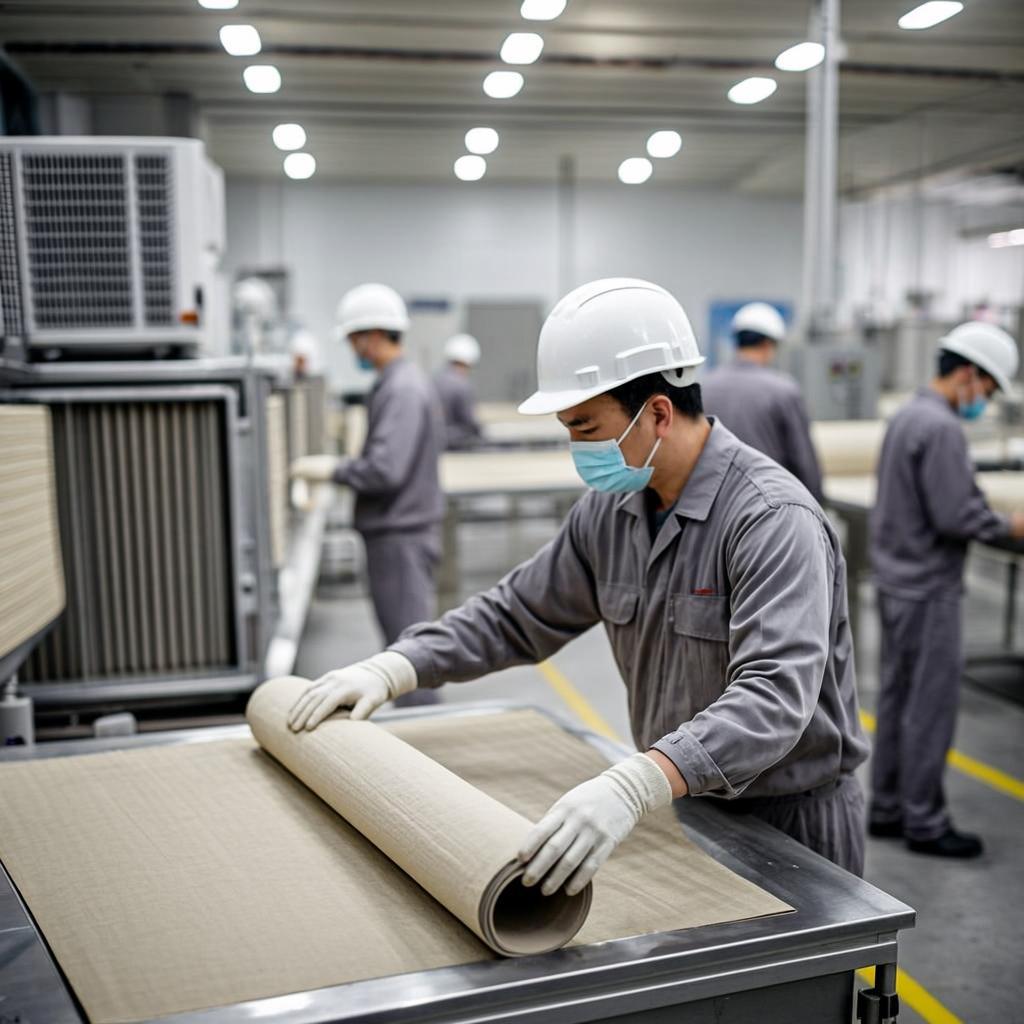
Electrostatic filter cotton is a high-performance non-woven filtration media engineered for superior particle capture in demanding air purification applications. Produced through advanced melt-blown
Electrostatic Filter Cotton
Product Overview
Electrostatic filter cotton is a high-performance non-woven filtration media engineered for superior particle capture in demanding air purification applications. Produced through advanced melt-blown technology and electret treatment, this specialized material integrates polypropylene fibers charged with electrostatic properties, enabling it to effectively trap microscopic particles such as dust, pollen, bacteria, viruses, and PM2.5 without significantly impeding airflow.
Designed for industrial and commercial use, electrostatic filter cotton excels in environments requiring reliable filtration efficiency and low pressure drop. It is widely utilized in respiratory protection, HVAC systems, and cleanroom operations, where maintaining air quality is paramount. The electrostatic charge on the fibers creates a "capture zone" that attracts and holds contaminants, outperforming traditional mechanical filtration methods. Available in various grades tailored to specific particle sizes and flow rates, our electrostatic filter cotton ensures optimal balance between filtration performance and energy efficiency.
With consistent quality backed by rigorous testing, this product meets international standards for air filtration, making it an ideal choice for manufacturers seeking durable, high-efficiency media. Whether for medical-grade masks or heavy-duty industrial filters, electrostatic filter cotton delivers proven results in safeguarding air quality across diverse sectors.
Key Features
- Advanced Electret Technology: Permanent electrostatic charge enhances particle adhesion, achieving filtration efficiencies exceeding 95% for 0.3μm particles.
- Low Air Resistance: Minimal pressure drop (typically under 30 Pa) ensures energy-efficient operation in ventilation systems.
- High Dust Holding Capacity: Retains substantial contaminant loads before requiring replacement, extending service life.
- Uniform Fiber Structure: Melt-blown process creates consistent microfiber networks for reliable performance.
- Customizable Specifications: Available in multiple grammages, thicknesses, and charge levels to suit specific applications.
- Antimicrobial Properties: Inhibits bacterial growth on the surface, ideal for healthcare and hygiene-focused uses.
- Environmentally Stable: Resistant to humidity and temperature variations, maintaining efficacy in real-world conditions.
Technical Specifications
| Parameter | Standard Grade | High-Efficiency Grade | Ultra-Fine Grade | Test Method |
|---|---|---|---|---|
| Material | Polypropylene Meltblown | Polypropylene Meltblown | Polypropylene Meltblown | - |
| Grammage (gsm) | 20-25 | 25-30 | 18-22 | GB/T 24218.1 |
| Thickness (mm) | 0.20-0.25 | 0.25-0.30 | 0.15-0.20 | GB/T 24218.2 |
| Filtration Efficiency (% for 0.3μm NaCl) | >95 | >99 | >98 | GB/T 3883 / EN1822 |
| Air Permeability (L/m²/s) | 120-150 | 100-130 | 140-170 | GB/T 5453 |
| Pressure Drop (Pa at 32L/min) | <25 | <30 | <20 | GB/T 3883 |
| Electrostatic Potential (kV) | >4.0 | >5.0 | >4.5 | Internal Electret Test |
| Bacterial Filtration Efficiency (BFE %) | >99 | >99.9 | >99.5 | ASTM F2101 |
| Particulate Filtration Efficiency (PFE %) | >98 | >99.5 | >99 | ASTM F2299 |
| Operating Temperature (°C) | -20 to +80 | -20 to +80 | -20 to +80 | - |
| Humidity Resistance (% RH) | Up to 95 | Up to 95 | Up to 95 | Internal Aging Test |
Note: Specifications are subject to customization based on client requirements. All data derived from standardized laboratory conditions.
Application Scenarios
Electrostatic filter cotton is versatile across industries where air quality control is critical. In personal protective equipment (PPE), it forms the core layer in N95, KN95, and surgical masks, providing reliable defense against airborne pathogens and fine particulates during healthcare procedures or public health emergencies.
For HVAC and air purification systems, it integrates into HEPA filters and pre-filters, capturing indoor pollutants in commercial buildings, hospitals, and data centers. Its low resistance supports efficient airflow in large-scale ventilation setups.
In industrial environments, electrostatic filter cotton addresses dust and fume challenges in manufacturing, pharmaceuticals, and electronics assembly. Cleanrooms benefit from its ultra-fine particle retention, ensuring compliance with ISO 14644 standards.
Automotive applications include cabin air filters, where it removes road dust, allergens, and exhaust particles, enhancing passenger comfort. Additionally, it serves in vacuum cleaners, fume hoods, and wastewater treatment odor control systems, demonstrating broad adaptability.
Engineers appreciate its compatibility with pleating, lamination, and activation processes, enabling seamless incorporation into multi-layer filter assemblies for specialized needs like high-humidity or oil-mist filtration.
Advantages
Electrostatic filter cotton offers distinct advantages over conventional filter media. The electret charge mechanism provides electrostatic attraction, boosting capture rates for submicron particles that mechanical filtration alone cannot effectively handle. This results in superior performance metrics, such as BFE and PFE exceeding industry benchmarks.
Its lightweight construction and high dust-holding capacity reduce replacement frequency, lowering operational costs and downtime. Unlike charged media that lose efficacy quickly in humid conditions, our electrostatic filter cotton retains charge stability up to 95% RH, ensuring long-term reliability.
Manufacturability is enhanced by excellent tensile strength and uniformity, facilitating high-speed production lines. Environmentally, it supports sustainable practices with recyclable polypropylene base and minimal energy use during operation due to low pressure drop.
Compared to glass fiber or activated carbon alternatives, it avoids issues like fiber shedding or chemical degradation, delivering safer, cleaner filtration. Rigorous quality controls, including charge decay testing and particle counting, guarantee batch-to-batch consistency for B2B reliability.
Why Choose Us
As a leading manufacturer of electrostatic filter cotton, we leverage over 15 years of expertise in non-woven filtration technologies. Our state-of-the-art production facilities employ proprietary electret charging processes, ensuring products surpass EN 149, ASTM F2100, and GB 19083 standards.
We prioritize customization, offering tailored formulations for unique airflow, efficiency, or size requirements. ISO 9001 and ISO 13485 certifications underscore our commitment to quality management and medical-grade compliance.
Advanced R&D capabilities enable continuous innovation, such as enhanced charge retention formulas for extreme environments. Global supply chain efficiency supports scalable volumes, from prototypes to millions of square meters, with stringent traceability and third-party validations.
Our electrostatic filter cotton is trusted by Fortune 500 clients in filtration, automotive, and healthcare sectors, reflecting proven performance and partnership value.
FAQ
What is electrostatic filter cotton?
Electrostatic filter cotton is a melt-blown non-woven fabric treated with electret technology to impart a permanent static charge, enhancing its ability to capture fine particles through both mechanical and electrostatic mechanisms.
How does the electrostatic charge work in filter cotton?
The charge creates an electrostatic field that polarizes and attracts neutral particles, improving filtration efficiency without increasing pressure drop. This charge remains stable over time under normal conditions.
What particle sizes can electrostatic filter cotton capture?
It effectively filters particles from 0.1μm to 10μm, including PM2.5, viruses (0.3μm), and bacteria, with efficiencies over 95% depending on the grade.
Is electrostatic filter cotton suitable for medical masks?
Yes, high-efficiency grades meet NIOSH N95 and equivalent standards, providing robust protection in respiratory devices.
How does humidity affect electrostatic filter cotton performance?
Our advanced formulations maintain over 80% charge retention at 85% RH, outperforming standard electrets.
Can electrostatic filter cotton be laminated with other materials?
Absolutely; it bonds seamlessly with spunbond, SMS fabrics, or hot-air cotton for multi-layer constructions.
What certifications does your electrostatic filter cotton hold?
Products comply with ISO 13485, CE marking, and specific tests like ASTM F2101 for BFE/PFE.
Related product
- English
- Françai
- Español
- Deutsch
- Română
- العربية
- 한국어
- 日本語
- Italiano
- Português
- Gaeilge
- Dansk
- Čeština
- Русский
- Afrikaans
- Euskara
- Català
- Esperanto
- हिन्दी
- Ελληνικά
- Bahasa Melayu
- Polski
- Српски
- Kiswahili
- ภาษาไทย
- Tiếng Việt
- Türkçe
- Svenska
- Cymraeg
- Slovenčina
- Latviešu
- Malti
- Magyar
- Galego
- ગુજરાતી
- Eesti Keel
- বাংলা
- Shqip
- беларуская мова
- Nederlands
- Tagalog
- ქართული
- Íslenska
- Kreyòl Ayisyen
- Lietuvių
- Norsk
- slovenščina
- தமிழ்
- Українська
- ײִדיש
- اردو
- తెలుగు
- فارسی
- македонски
- ಕನ್ನಡ
- Bahasa Indonesia
- עברית
- Suomi
- Hrvatski
- Български
- Azerbaijani