

High-Performance Activated Carbon Composite Filter Media for Industrial Air & Gas Purification
In today's industrial landscape, meeting stringent air quality standards and protecting downstream processes are non-negotiable. Our advanced activated carbon composite filter media represents a breakthrough in adsorption technology, engineered to deliver superior contaminant removal, extended service life, and operational reliability for demanding B2B applications.
1. Product Overview
This specialized activated carbon composite filter media is a meticulously engineered laminate structure combining high-grade activated carbon with supportive non-woven fabric layers. Unlike standard carbon pads, this composite design maximizes the effective surface area of activated carbon while providing exceptional structural integrity and low airflow resistance. It is specifically formulated to target and capture a broad spectrum of volatile organic compounds (VOCs), odors, acid gases, and other airborne molecular contaminants in industrial and commercial settings.
2. Key Features
- Multi-Layer Composite Construction: Integrates high-adsorption carbon with pre-filtration and support layers for optimal performance and durability.
- Broad-Spectrum Contaminant Removal: Effectively adsorbs VOCs, fumes, odors, sulfur compounds, and various acidic/alkaline gases.
- High Dust-Holding Capacity: The integrated pre-filter layer captures particulate matter, preventing premature clogging of the carbon layer and extending media life.
- Low Airflow Resistance: Engineered for efficient air passage, reducing energy consumption in HVAC and air handling systems.
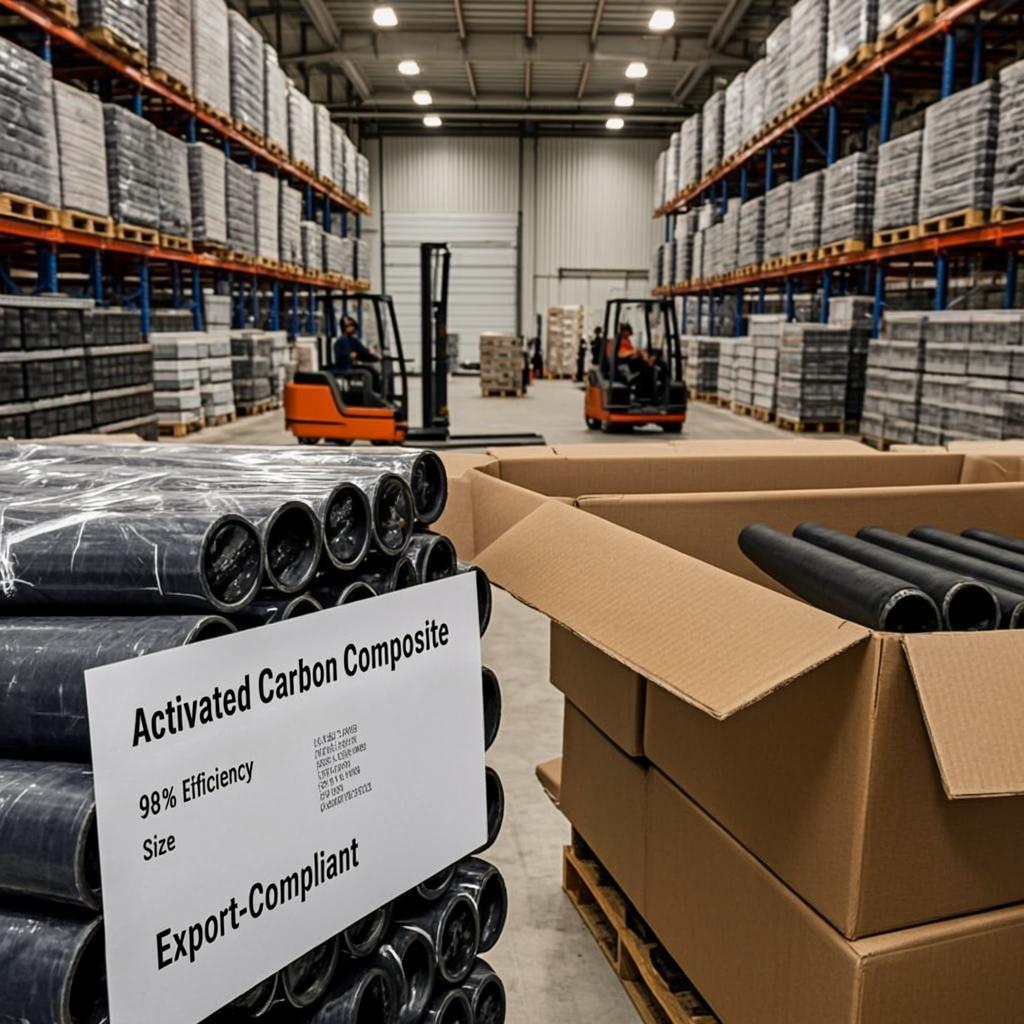
- Customizable Form Factors: Available in rolls, panels, pads, and custom die-cuts to fit any filter frame or system design.
- Fire-Retardant & Corrosion-Resistant Options: Special formulations available for demanding environments requiring enhanced safety and material compatibility.
3. Technical Specifications
| Parameter | Specification | Test Standard |
|---|---|---|
| Base Material | Impregnated Activated Carbon + Polyester Non-Woven | - |
| Carbon Content | 300 - 900 g/m² (Customizable) | Gravimetric Analysis |
| Thickness | 5 mm, 10 mm, 20 mm, 30 mm | ISO 9073-2 |
| Initial Pressure Drop (@ 5.3 cm/s) | 15 - 60 Pa (Depending on thickness & density) | ISO 9237 |
| Butane Activity (Minimum) | 50% | ASTM D5228 |
| Iodine Number (Typical) | 800 - 1000 mg/g | ASTM D4607 |
| Operating Temperature | -20°C to +80°C | - |
| Standard Roll Dimensions | 1.2m x 50m, Custom widths available | - |
4. Application Scenarios
Our activated carbon composite filter media is versatile and critical for air purification across numerous sectors:
- Industrial Manufacturing: Fume extraction in welding, painting, chemical processing, and plastics manufacturing.
- HVAC & Building Air Quality: Final-stage filtration in commercial HVAC systems, airports, shopping malls, and office buildings to remove outdoor pollutants and indoor odors.
- Food & Beverage Processing: Control of odors in processing areas, packaging rooms, and refrigerated storage.
- Pharmaceutical & Laboratories: Containment of chemical vapors and maintenance of cleanroom air quality in R&D and production facilities.
- Wastewater Treatment & Composting: Abatement of high-concentration malodorous compounds like hydrogen sulfide, ammonia, and mercaptans.
- Electronics & Semiconductor: Removal of airborne molecular contamination (AMC) that can damage sensitive components during production.
5. Advantages
Choosing our composite media over traditional solutions delivers tangible operational benefits:
- Extended Service Intervals: The composite structure acts as a combined particulate and gas-phase filter, reducing change-out frequency and lowering long-term maintenance costs.
- Enhanced System Efficiency: Low initial pressure drop translates directly to lower fan energy costs over the filter's lifespan.
- Consistent Performance: Uniform carbon distribution and robust construction prevent channeling and ensure predictable, reliable adsorption throughout the media's life.
- Easy Installation & Replacement: Flexible yet sturdy media is easy to handle, cut, and fit into existing filter housings or frames.
- Tailored Solutions: We offer chemical impregnations (e.g., potassium iodide for mercury, potassium permanganate for broader gas removal) to target specific contaminant challenges.
6. Why Choose Us
As a specialist manufacturer in filtration media, we provide more than just a product:
- Deep Technical Expertise: Our engineering team works with you to analyze contaminant profiles and recommend the optimal activated carbon composite filter media formulation.
- Rigorous Quality Control: Every batch undergoes performance testing to ensure it meets published specifications and your performance expectations.
- Global Supply Chain Reliability: We maintain consistent stock of key grades and offer flexible logistics for reliable, on-time delivery worldwide.
- Commitment to Innovation: We continuously invest in R&D to improve adsorption capacity, material science, and sustainability of our media products.
- Dedicated B2B Support: From sample provision to technical datasheets and application guidance, we partner with you for successful integration.
7. FAQ
Q: How do I determine the correct thickness and carbon loading for my application?
A: The selection depends on contaminant type, concentration, required removal efficiency, and face velocity. We provide a detailed application questionnaire to gather this data and recommend the most cost-effective specification. Generally, higher concentrations and harder-to-adsorb gases require thicker media with higher carbon loading.
Q: Can this media be used in high-humidity environments?
A: Yes, our standard composite media performs well in moderate humidity. For environments with consistently high relative humidity (>80%), we recommend a specially treated hydrophobic activated carbon composite filter media to minimize the adsorption of water vapor, which can compete with target contaminants.
Q: What is the typical service life, and how do I know when to replace it?
A: Service life varies greatly based on contaminant load and airflow. It can range from 3 to 12 months. Monitoring methods include scheduled replacement based on historical data, tracking pressure drop increase, or using downstream gas sensors. We can help establish a cost-effective maintenance schedule.
Q: Do you offer custom impregnations or composite blends?
A: Absolutely. A key advantage of our manufacturing capability is customization. We can impregnate the carbon with specific chemicals to target compounds like formaldehyde, ammonia, or mercury. We can also create blends with different carbon types or incorporate additional functional layers.
Q: Is the media recyclable or disposable?
A: Spent activated carbon composite filter media is typically classified as industrial waste and must be disposed of according to local regulations, especially if it has captured hazardous vapors. We advise on proper disposal practices. Some clients explore thermal reactivation services for high-volume spent carbon, which we can discuss on a case-by-case basis.