

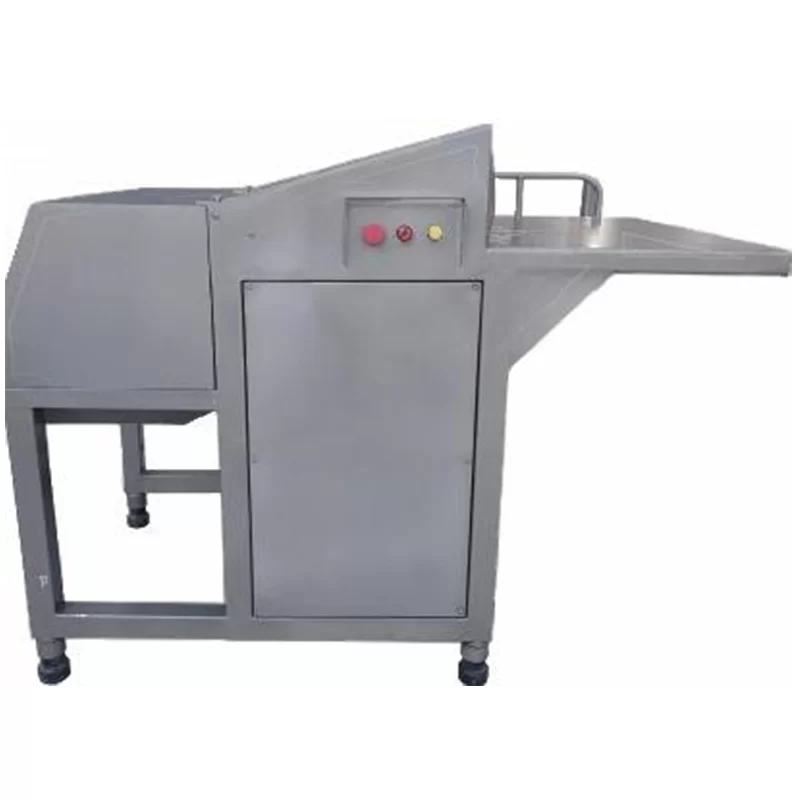
Deploying a heavy-duty OEM frozen meat chopper within cold-chain operations requires careful consideration of low-temperature fatigue failure and stainless steel metallurgy. Under sub-zero processing conditions, structural metals and cutting assemblies undergo intense cyclic stress while being exposed to organic acids, moisture, and aggressive sanitization chemicals. Selecting the correct alloy chemistry and surface treatment is fundamental to ensuring long-term asset integrity and hygienic performance.
1. Austenitic vs. Martensitic Stainless Steels in Impact Tools
Engineers designing high-impact cutting and sizing tools must balance hardness with impact toughness. While 300-series austenitic stainless steel (such as 304 and 316L) offers superior corrosion resistance due to its rich nickel-chromium matrix, its lower yield strength renders it prone to premature dulling under continuous impact with frozen substrates. Consequently, high-wear cutting components rely on martensitic stainless steels (e.g., 440C or specialized nitrogen-alloyed grades) that undergo precise vacuum heat treatment.
Furthermore, structural frames and volumetric transport augers in a heavy-duty OEM sausage meat machine rely heavily on passivated 304/316 grade stainless alloys to resist pitting corrosion caused by organic acids and saline solutions. Partnering with a premium manufacturer capable of executing advanced CNC machining ensures tight tolerances, minimizing stress concentration points across high-load structural joints.
2. Tribological Wear and Polymer Seal Integrity under High Load
Dynamic seals and bushings within high-pressure food processing machinery operate under stringent tribological constraints. Traditional rubber elastomers frequently suffer from embrittlement and thermal shrinkage in sub-zero environments, leading to loss of seal compression and fluid ingress. Modern material engineering solves this by deploying ultra-high-molecular-weight polyethylene (UHMW-PE) and modified polytetrafluoroethylene (PTFE) formulations.
These advanced polymers exhibit exceptionally low friction coefficients, high abrasion resistance, and compliance with stringent global food safety standards. When paired with polished stainless steel shafts, high-performance seals maintain structural memory under continuous pressure differentials, preventing lubricant leakage and process contamination.
3. Surface Finishing and Hygienic Micro-Structure Standards
The microscopic topography of food-contact surfaces directly governs bacterial adhesion and cleanability. Mechanical grinding alone often leaves micro-cavities where biofilms can anchor. Advanced electropolishing processes smooth microscopic peaks and valleys, yielding a surface roughness ($Ra$) below 0.4 micrometers while enriching the chromium oxide passivation layer.
By integrating superior metallurgy, specialized polymer engineering, and rigorous surface passivations, industrial processing machinery can achieve high operational reliability under extreme thermal and mechanical stresses. Continued advancement in material science remains pivotal to elevating sanitation standards and equipment operational lifespans throughout the global food processing sector.